

He Moved to a Medieval Village... and Heard the Stones Speak
Antonio Romani on history, memory, and reinventing his life stone by stone.

Dear friends,
Last week I returned from a restorative writing retreat in Tuscany with the inspiring teacher Alan Watt—who was my first interviewee here on Writers at the Well—and am still under the spell of rolling vineyards and cypress trees as I sit down to share today’s conversation with my new guest, Antonio Romani. The timing is a gift. Having experienced the landscape firsthand, I can understand why Romani made the bold move of relocating to a tiny medieval borgo in Lunigiana in northwest Tuscany. His new book, The Patient Wait of the Stones (Galpón Press), is the luminous record of what he found there.
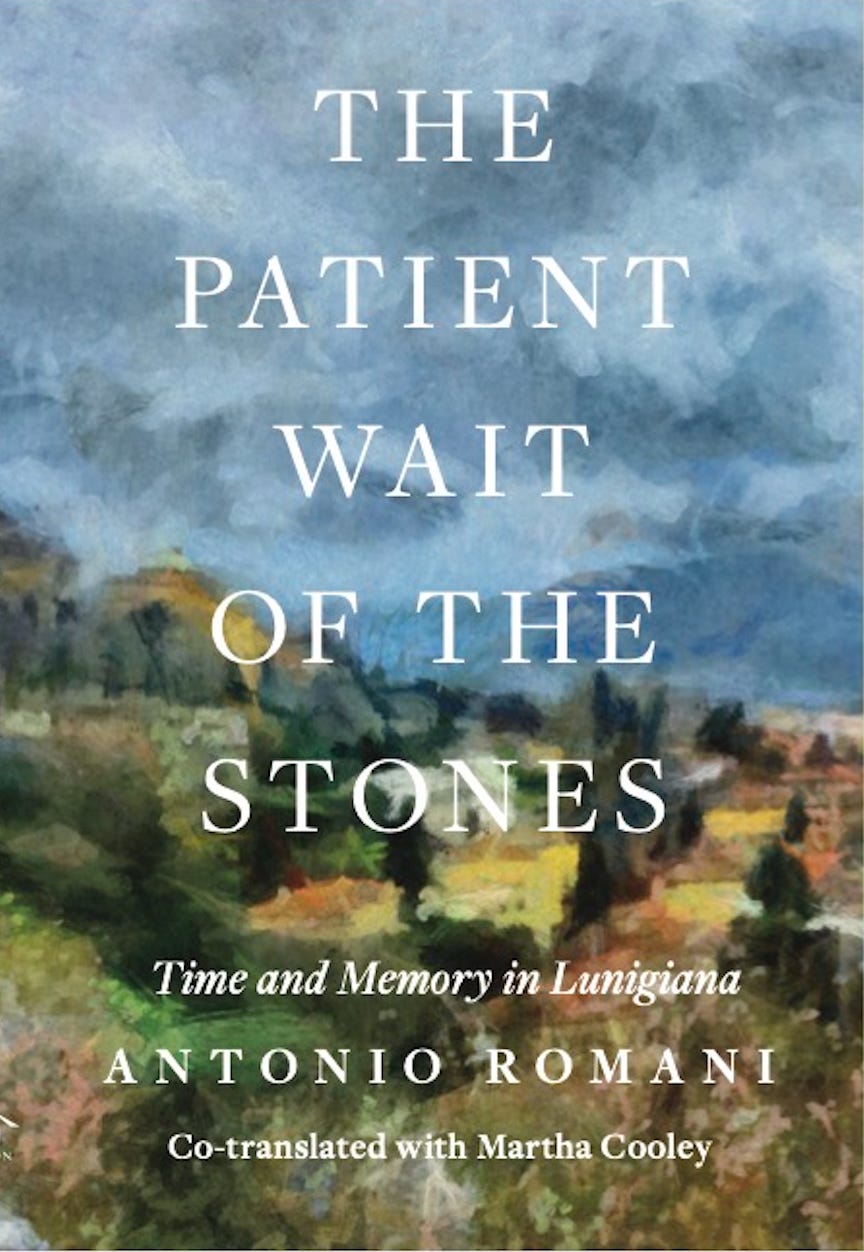
A personal and historical literary narrative, the book chronicles Romani’s late-in-life move with his wife and co-translator, novelist Martha Cooley. As he explores the rich history of the region, he simultaneously unearths the buried boulders of his own past, blending inner and outer landscapes in mesmerizing prose. The dry-stone walls he painstakingly restores reveal not only the secrets of Lunigiana, but those within his own heart.
A former teacher and bookseller, Romani is an essayist and co-translator of Time Ages in a Hurry by Antonio Tabucchi (Archipelago Books, 2015). His essay on Elena Ferrante was a Notable in Best American Essays 2016.
“A life-affirming account of reinvention, learning, books, love, death—and, of course, plenty of stones.” ~ Kirkus Reviews, starred review
If you can’t visit Tuscany in person, treat yourself to a vicarious immersion through Romani’s The Patient Wait of the Stones. And if you’d like to explore Martha Cooley’s parallel lens on life in Castiglione, don’t miss my recent conversation with her here on Writers at the Well.
Yours at the well,
Tess
The book itself is physically gorgeous—the cover, the typesetting inspired by 15th-century typeface. Can you talk about those choices and what you wanted the book as an object to convey?
I love the cover of my book. The Italian version’s cover shows a portion of the castle that sits just across from our house in Castiglione del Terziere. But that image is not as evocative as this new one, in which the watercolor’s hazy contours and the sweep of the sky convey the sense of openness (with its mix of uncertainty and possibility) that I feel in Lunigiana. I should add that my book is printed in a beautiful font called Aldine created by Francesco Griffo, a fifteenth-century type font designer and engraver, in honor of Aldo Manuzio, his boss and a famous Venetian printer and publisher. By a happy coincidence, my friend Paolo Tinti recently published Il Metallo e La Lettera, a book about Griffo’s life and work. We’re both giving Griffo some love.
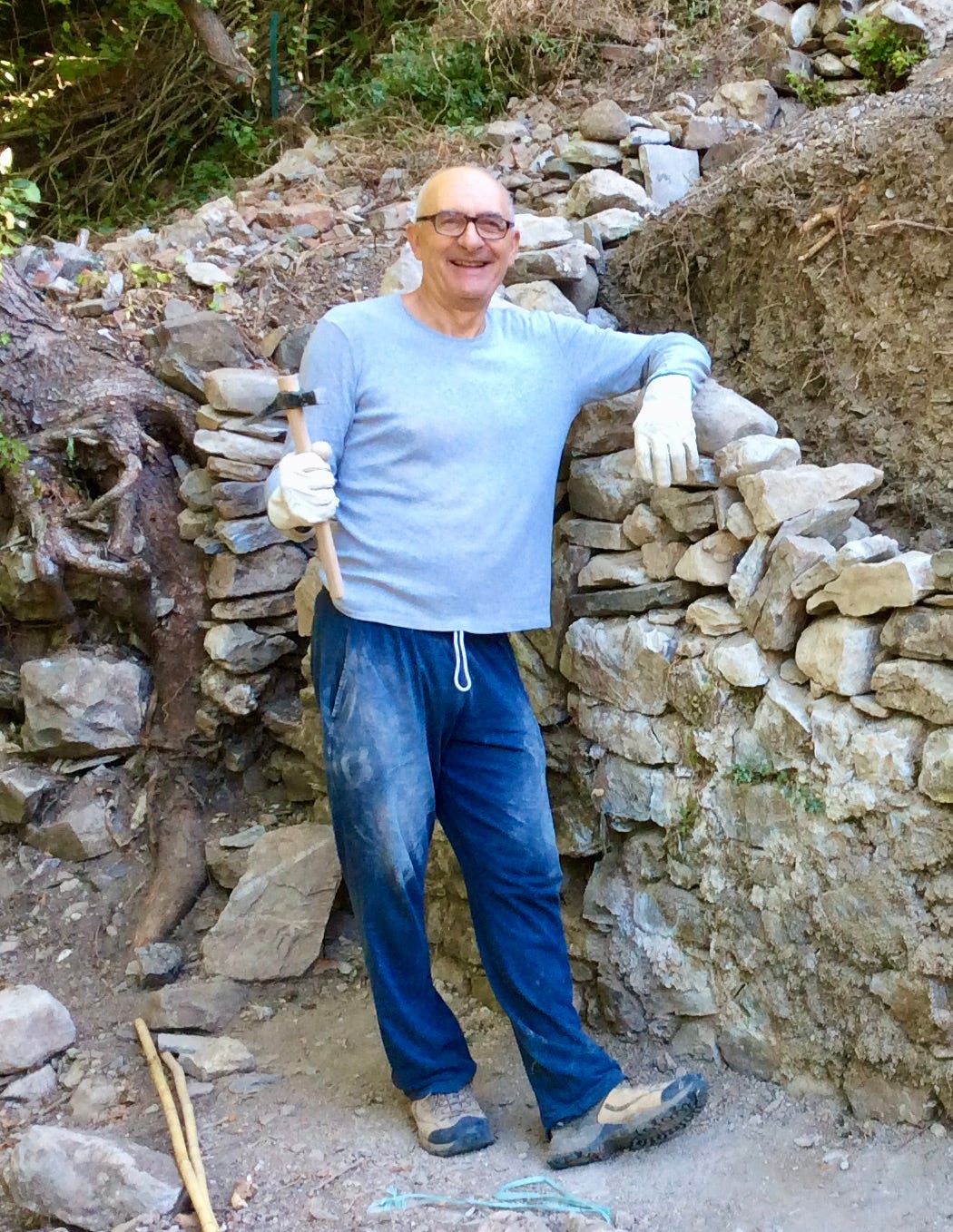
You describe the stone wall you discovered buried on your property as having been built not to divide the land, but to support it. Can you share why this moved you so deeply?
Dry-stone walls are essential for sustaining soil terraces on the steep slopes of foothills. They prevent surface erosion of the hills, allow cultivation even on rough land, and help maintain a natural ecosystem while doing no harm to the environment. Dry-stone walls have been the bulwark of “hillside economies” for centuries, not just in Italy but all over the world.
Through the stones of the walls on my land, I’ve felt for the first time in physical touch with the complex stratifications of history, those layers about which I’d hitherto only read or fantasized. In the borgo (medieval village) where I live, everything is made of stones. From them I’ve learned to listen to the true history of the human beings who built with their own hands their homes here—and the borgo’s castle, too. The stones represent for me (and are in fact) a foundation that sustains and nourishes ongoing metamorphoses of the human story.
Not infrequently I am caught by a kind of disquiet, a temptation to close myself up, as if fleeing from reality could be an extreme defense against pain. Yet here in Castiglione I seemed to be better able to maintain my personal version of the Epicurean state of ataraxia: a deep calmness, the pursuit of which is never definitive and requires constant adjustments and reinforcements—like a dry-stone wall. Living in solitude along with Martha, my wife, in a kind of limbo between chaos and necessity, I seem to hear the stones whispering to me: You are free.
You write that you pause “…to hear, in the murmur of the stones, the voices of those who knew how to pick up that murmur before me, in literature and in art.” How did writing this book deepen your sense of connection to people of the past?
The stones recount to me the melding of nature and history that has shaped the language, customs, and mentality of Lunigianese people whose stories went unheard, overcome by more powerful forces. My challenge was to try to understand how and at what price generations of poor peasants had to reckon with nature—using more or less the same tools and techniques until just a few decades ago, and bearing their miserably exploited condition as though it were the only possible version of their existence.
From afar, the stones seem to veil everything in a uniform gray. But if you wait and let your gaze linger, beneath that veil you will soon discover a drama of diverse forms and a startling variety of color, changing from moment to moment. The stones will install themselves in your memory, offering themselves as a new lexicon that expands your capacity to imagine. In my case they have helped me imagine my precursors here, the stone artists, as I think of them. I was very glad to learn that the art of building dry-stone walls was declared by UNESCO as a non-material patrimony of humanity.
You write about your oath-taking ceremony to become a citizen of the United States. Do you experience the world differently as a dual citizen? Has living between two national identities sharpened your sense of what it means to truly belong to a place?
Being labeled a dual citizen, I feel privileged and yet wish to belong to more than two nations. To me, “belonging” isn’t necessarily related to a nation; indeed, I think the concept of national identity is meaningful only in a historical sense, not in an experiential one. I see myself as a global citizen, in a world that has become smaller and smaller, and thus offers many more chances to experience its amazing diversity. Belonging to a new place implies an enrichment rather than a replacement of identity. The challenge is to remain curious and forgo judgment in favor of exploration. As for my local experience, people here keep calling me “the American” or “the Cremonese.” I hope they will come to recognize me as a person who is pursuing happiness. This is the true act of belonging, the aim and right we all share, regardless of where we were born or where we live now.
The Patient Wait of the Stones was published in Italy in 2023 (by Maria Pacini Fazzi Editore in Lucca) as La Paziente Attesa delle Pietre. Co-translator Martha Cooley is the author of three novels (The Archivist, Thirty-Three Swoons, and Buy Me Love), a memoir (Guesswork), and a recently published collection of essays, My Little Donkey (Catapult, 2025).
Catch Antonio and Martha on their book tour:
Wed., June 3, 7 pm: Community Bookstore, Brooklyn, NY (please reserve a seat).
Fri., June 5, 6 pm: Battenkill Books, Cambridge, NY
Sat., June 6, 3:30 pm: Merritt Bookstore, Millbrook, NY
Thur., June 11, 7 pm: Newtonville Books, Newtonville, MA
Sun., June 14, 5 pm: Celia Bookshop, Swarthmore, PA
Check out my recent interviews with Andrew Holecek, George Saunders, and Karen Dukess. Stay tuned for upcoming conversations with Pulitzer Prize winning playwright and novelist Ayad Akhtar—whose work you may know from Disgraced or Homeland Elegies—as well as novelists Susan Donovan Bernhard and Halle Shepherd.